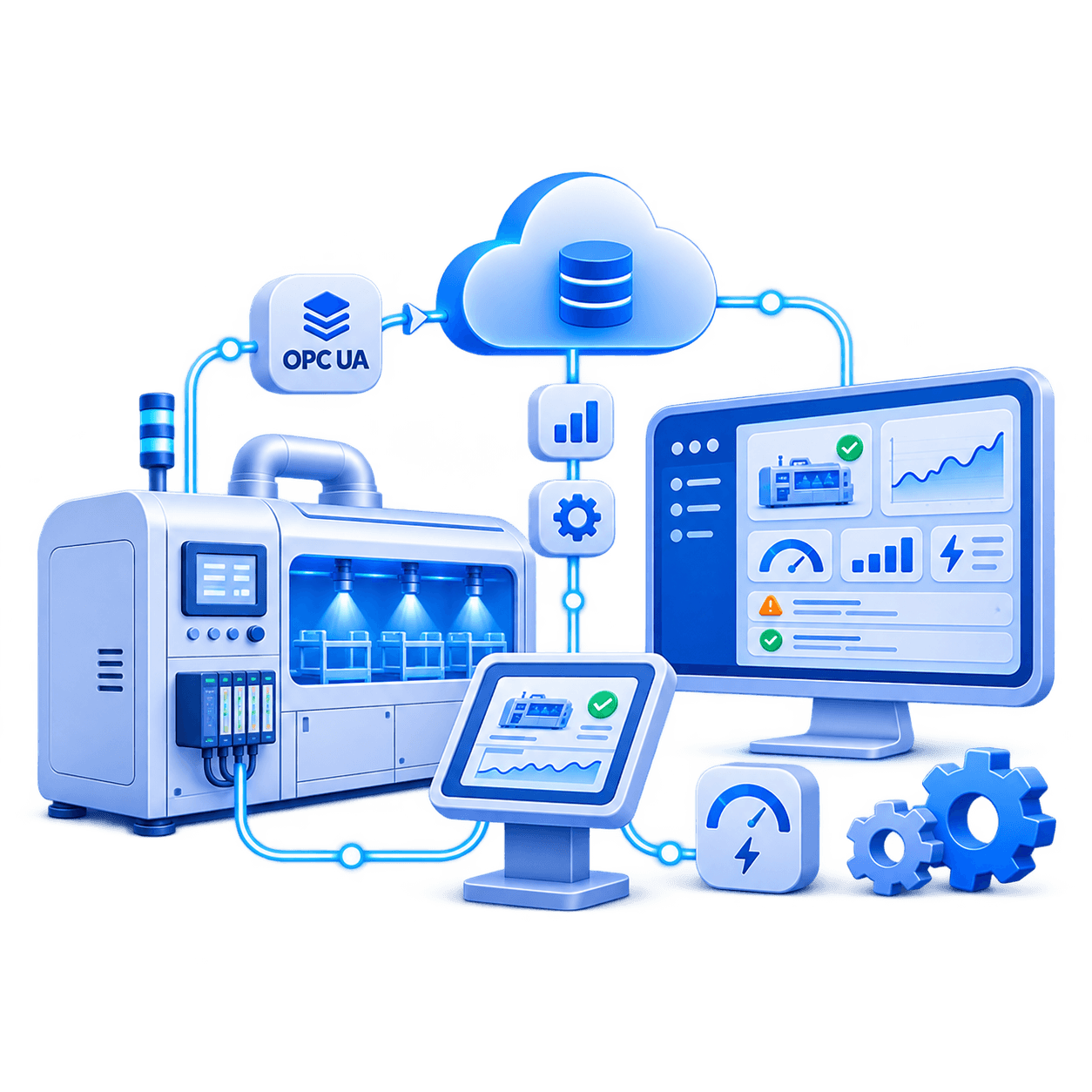
At Mindtech Apps, we help industrial machinery manufacturers, OEMs, and manufacturing companies transform traditional equipment into intelligent, cloud-connected systems. Our industrial IoT development and PLC-to-cloud integration services connect existing automation infrastructure with modern cloud platforms, enabling real-time machine monitoring, operational analytics, remote diagnostics, and data-driven maintenance.
Using industry-standard communication protocols such as OPC UA and Modbus TCP, we integrate PLC-controlled machinery, industrial sensors, and energy meters with scalable cloud-native applications built on Microsoft Azure, AWS, and modern software technologies. Whether you're looking to cloud-enable existing machinery, develop a centralized equipment monitoring platform, or introduce new digital services for your customers, our engineering team delivers end-to-end solutions from industrial connectivity and backend architecture to web applications, operator terminals, and cloud infrastructure.
Turn your industrial equipment into connected digital products.
Cloud-Enable Your Industrial Machinery Without Replacing Existing Automation Systems
Industrial machinery manufacturers increasingly need to provide more than reliable physical equipment. Customers expect greater operational transparency, remote access to machine information, proactive maintenance capabilities, and connected digital services. However, industrial equipment often operates through isolated PLC systems, local industrial networks, and proprietary interfaces, making it difficult to access operational data remotely or consolidate information across multiple facilities.
Our PLC-to-cloud integration solutions bridge the gap between operational technology (OT) and modern information technology (IT), connecting existing machines to scalable software platforms without requiring a complete redesign of their control systems.
By extending your existing automation infrastructure with secure data connectivity and cloud-based applications, we help unlock new capabilities for equipment monitoring, maintenance, production analytics, and remote services.
Real-Time Machine Monitoring
Access live machine status, operational metrics, alarms, and performance indicators through centralized industrial dashboards.
Remote Equipment Management. Monitor industrial machinery deployed across customer sites and production facilities without requiring constant on-site access.
Predictive Maintenance Readiness
Collect and structure machine telemetry, diagnostic information, and historical operating data to establish a foundation for predictive maintenance and condition monitoring.
Industrial Data Analytics
Transform machine-generated data into actionable operational insights, supporting production optimization, equipment utilization analysis, and energy monitoring.
New Digital Services for Equipment Manufacturers
Extend your machinery portfolio with connected monitoring solutions, customer portals, remote diagnostics, and subscription-based digital services.
Our Industrial IoT and PLC-to-Cloud Development Services
Mindtech provides end-to-end Industry 4.0 software development services, combining industrial system integration with modern cloud engineering, web application development, and DevOps expertise.
PLC-to-Cloud Integration
We connect industrial PLC controllers to modern cloud infrastructure, enabling secure and reliable access to operational data from connected machinery.
Our engineers develop integration layers that collect machine telemetry, operating states, alarms, production metrics, and diagnostic information and make them available to centralized software applications.
Using OPC UA, Modbus TCP, and custom industrial integration services, we bridge existing automation infrastructure with cloud-native backend systems.
Our solutions are designed around the specific connectivity, security, and operational requirements of industrial environments.
Industrial IoT Platform Development
We design and develop custom industrial IoT software platforms that connect, monitor, and manage industrial equipment across distributed production facilities and customer locations. Our scalable backend architectures support real-time telemetry ingestion, event-driven processing, equipment management, operational workflows, and integration with enterprise software systems. Using modern technologies such as Java, Kotlin, C#, NestJS, Node.js, python, PHP, TypeScript, RabbitMQ, Redis, and cloud-native microservices, we build maintainable platforms capable of evolving alongside your connected machinery ecosystem.
Industrial Equipment Monitoring Software
We develop custom web-based monitoring platforms that provide real-time visibility into connected industrial assets.
Our solutions combine live equipment information with historical data, enabling operators, maintenance personnel, and management teams to monitor machinery through intuitive dashboards. Typical capabilities include machine status monitoring, alarm management, equipment utilization tracking, production metrics, operational reporting, and maintenance planning. Using Next.js, React, TypeScript, and WebSocket-based communication, we deliver responsive industrial applications with live data updates.
Remote Diagnostics and Predictive Maintenance Systems
Unexpected equipment failures and unplanned downtime can create significant operational costs for industrial businesses.
By connecting machinery to centralized software platforms, we help manufacturers collect the operational and diagnostic data needed to identify equipment issues earlier and improve maintenance planning. Our solutions support condition monitoring, diagnostic event collection, historical equipment analysis, maintenance alerts, and the integration of predictive maintenance models. Where appropriate, we can extend these capabilities with AI and machine learning to identify patterns and anomalies in machine-generated data.
Industrial Energy Monitoring and Optimization
Understanding industrial energy consumption is increasingly important for manufacturers seeking to improve efficiency and manage operational costs.
We integrate industrial energy meters and monitoring devices using protocols such as Modbus TCP, enabling the collection and analysis of energy consumption data. By combining energy metrics with machine operating states and production information, our software helps companies understand consumption patterns and identify opportunities for operational optimization.
These capabilities can support energy reporting, production efficiency analysis, and broader industrial sustainability initiatives.
Industrial Operator Terminals and Shop-Floor Applications In addition to centralized cloud platforms, we develop custom industrial applications and shop-floor interfaces that bring operational information directly to production personnel. These solutions provide real-time machine status, production workflows, operational instructions, alerts, and key performance indicators through dedicated terminals or industrial devices. By connecting operator interfaces to a shared backend platform, we help maintain consistent information between physical production environments and centralized management systems.
Cloud, On-Premises, and Hybrid Industrial Infrastructure
Industrial companies have different infrastructure and security requirements. While some manufacturers prefer cloud-hosted platforms, others require local deployment because of operational policies, network restrictions, or data governance requirements.
We design industrial software architectures that can support Microsoft Azure, AWS, standalone on-premises installations, and hybrid deployment models.
Using Kubernetes, containerized services, and Infrastructure as Code, we build consistent deployment environments designed for scalability, resilience, and maintainability. This flexibility allows industrial equipment manufacturers to offer connected software solutions to customers with different infrastructure requirements.
OPC UA, Modbus TCP, and Industrial Communication Integration
Reliable industrial connectivity is fundamental to successful Industry 4.0 software development. At Mindtech, we integrate modern applications with existing industrial automation systems using established communication technologies.
OPC UA Integration
OPC UA provides a standardized approach to exchanging data between industrial equipment and software systems. We use OPC UA to connect PLC-controlled machinery with data collection services and cloud platforms, enabling access to machine status, telemetry, and operational events.
Modbus TCP Integration
We implement Modbus TCP connectivity for industrial devices such as energy meters and other compatible equipment, integrating operational and consumption data into centralized monitoring platforms.
Real-Time Industrial Data Processing
Machine-generated information is processed through scalable backend services and event-driven architectures, enabling data aggregation, historical storage, and delivery to monitoring applications.
Secure OT-to-IT Connectivity
We design integration architectures that account for industrial network boundaries, authentication, encrypted communication where supported, and controlled access between operational systems and cloud infrastructure. Our goal is to connect existing industrial equipment to modern software ecosystems while respecting the reliability and security requirements of production environments.
Custom Industrial IoT Platforms vs. Off-the-Shelf Monitoring Software
Many industrial businesses initially consider generic IoT dashboards or off-the-shelf equipment monitoring platforms.
These solutions can be effective for basic monitoring requirements, but manufacturers with complex machinery, proprietary control logic, or specialized business processes often require greater flexibility. Custom industrial IoT software development allows manufacturers to build connected services around their equipment rather than adapting their products to the limitations of a predefined platform. A custom solution can accommodate specialized machine data structures, unique operating workflows, customer-specific interfaces, complex enterprise integrations, and different deployment requirements.
It also provides greater control over the software architecture, product roadmap, user experience, and long-term evolution of the platform.
For industrial machinery manufacturers looking to differentiate their equipment through digital capabilities, custom software can become an important part of their product offering.
Our Technology Stack for Industrial IoT Development
We combine industrial communication technologies with modern cloud-native software engineering.
Industrial Connectivity: OPC UA, Modbus TCP, PLC Integration, Industrial IoT, Telemetry Processing
Backend Development: NestJS, Node.js, TypeScript, Java, Kotlin, PHP, Python, C#, Microservices, RabbitMQ, Redis
Frontend Development: Next.js, React, TypeScript, WebSockets, Real-Time Dashboards
Cloud Infrastructure: Microsoft Azure, AWS, Kubernetes, Docker, Terraform
DevOps and Automation: Azure DevOps, CI/CD Pipelines, Infrastructure as Code, Automated Deployment
Deployment Models: Cloud, On-Premises, Hybrid Infrastructure
This technology stack enables us to build end-to-end industrial software ecosystems, connecting machinery and physical processes with scalable backend services and modern user-facing applications.
Our Industrial IoT Development Process
We follow an agile software development approach, combining industrial integration expertise with modern engineering practices.
1. Discovery and Industrial System Assessment
We begin by understanding your equipment, PLC infrastructure, communication protocols, existing IT systems, and business objectives.
Our team evaluates the available machine data, connectivity requirements, and deployment constraints to define a suitable integration architecture.
2. Architecture and Connectivity Design
We design the system architecture connecting industrial devices, data collection services, backend applications, and cloud or on-premises infrastructure.
Particular attention is given to data reliability, network boundaries, system maintainability, and operational requirements.
3. Industrial Integration and Software Development
Our engineers implement PLC connectivity, telemetry processing, backend services, real-time monitoring interfaces, and required enterprise integrations.
We use modern development practices and iterative delivery to validate the platform as functionality is introduced.
4. Testing, Deployment, and Infrastructure Automation
We implement automated testing, CI/CD pipelines, containerized deployments, and Infrastructure as Code to support consistent software delivery.
Deployment strategies are adapted to the requirements of the industrial environment, whether cloud-hosted, on-premises, or hybrid.
5. Continuous Development and Optimization
After deployment, we support ongoing software improvements, integration of additional equipment, performance optimization, and development of new connected services.
Our modular architectures are designed to accommodate future requirements as the connected machinery ecosystem grows.
Industry 4.0 Case Study: Cloud-Connected Industrial Surface Treatment Machinery
Developing a PLC-to-Cloud Platform for Industrial Equipment Manufacturers
Mindtech is developing a comprehensive industrial IoT platform for a manufacturer and operator of industrial surface treatment machinery, connecting PLC-controlled equipment deployed across multiple customer sites. The project involves direct integration with industrial machinery using OPC UA, alongside Modbus TCP connectivity for energy metering devices. Our team is building a cloud-native backend using NestJS microservices, RabbitMQ, and Redis, with real-time data delivery through WebSockets. The user-facing platform is developed with Next.js and TypeScript, offering machine monitoring dashboards, operational analytics, maintenance planning tools, and equipment management capabilities. The solution also includes connected shop-floor terminals that provide operators with direct access to production workflows and machine information.
The infrastructure is designed for Microsoft Azure with Kubernetes orchestration, Terraform-based provisioning, and Azure DevOps pipelines. The architecture also supports standalone on-premises deployment.
The result is an evolving industrial software ecosystem designed to transform existing PLC-controlled machinery into remotely monitored, cloud-connected equipment.
The platform establishes a foundation for future predictive maintenance, advanced operational analytics, and new digital services for the manufacturer's customers.
Explore the Industrial IoT & PLC-to-Cloud Case Study
AI-Driven Software Development for Industry 4.0
At Mindtech, we combine experienced software engineers with AI-assisted development methodologies, automated testing, and modern DevOps practices.
AI-assisted workflows help accelerate implementation, streamline repetitive engineering tasks, and support efficient code development while maintaining human oversight of software architecture, integration reliability, and security-critical decisions. For industrial software projects, this engineering approach is particularly valuable when developing complex integrations, cloud-native microservices, monitoring interfaces, and data processing systems.
Our focus is on using modern development tools to deliver reliable, maintainable software while respecting the operational requirements of industrial environments.
Why Choose Mindtech for Industrial IoT and PLC-to-Cloud Integration?
Industrial Connectivity Meets Modern Software Engineering
We combine practical experience with industrial integration technologies and modern software development, connecting traditional automation systems with scalable digital platforms.
Custom Solutions for Machinery Manufacturers
We develop software around your equipment, business processes, and customer requirements rather than relying on generic monitoring templates.
Cloud and On-Premises Expertise. Our engineering capabilities cover Microsoft Azure, AWS, Kubernetes, Terraform, and containerized architectures, supporting different industrial deployment requirements.
End-to-End Product Development
From connectivity architecture and backend development to industrial dashboards, operator terminals, and cloud infrastructure, we provide comprehensive engineering support.
Agile and AI-Assisted Development
Our collaborative development process combines iterative delivery, modern engineering practices, AI-assisted workflows, and continuous integration.
Experience with Complex IoT EcosystemsOur work includes connected industrial machinery platforms and RFID-enabled smart recycling infrastructure, demonstrating our ability to integrate physical systems with cloud-based applications.
Frequently Asked Questions About PLC-to-Cloud Integration and Industrial IoT
Can existing industrial PLCs be connected to the cloud?
Yes. Many existing PLC-controlled machines can be connected to cloud platforms using supported industrial communication protocols, integration gateways, and suitable software architectures. The approach depends on the PLC model, available interfaces, network infrastructure, and security requirements.
Do we need to replace our existing PLCs to implement Industry 4.0?
Not necessarily. In many cases, existing PLC infrastructure can be extended with connectivity services that collect operational data and make it available to cloud or on-premises software platforms. Compatibility and integration requirements should be assessed individually.
How does OPC UA cloud integration work?
OPC UA enables standardized communication between compatible industrial devices and software systems. An integration layer can collect machine data through OPC UA and securely transmit relevant information to backend services, where it can be processed, stored, and displayed through monitoring applications.
Can industrial IoT software run without a permanent cloud connection?
Yes. Depending on the architecture, industrial IoT software can be designed for on-premises operation, local data collection, or hybrid deployment. This is particularly useful for production environments with restricted connectivity or strict infrastructure requirements.
Can you connect machinery deployed across multiple customer sites?
Yes. We develop centralized industrial IoT platforms designed to aggregate information from equipment operating across distributed locations. The architecture can support site-specific connectivity, access controls, and centralized equipment monitoring.
Can PLC data be used for predictive maintenance?
Yes. Operational telemetry, machine events, diagnostic information, and historical performance data can provide a foundation for predictive maintenance. The effectiveness of predictive models depends on data quality, available measurements, operating conditions, and suitable analytical methods.
Do you develop custom industrial dashboards and operator applications?
Yes. We build modern industrial web applications, real-time monitoring dashboards, and shop-floor interfaces using React, Next.js, TypeScript, and WebSocket-based communication.
How much does industrial IoT development cost?
Development costs depend on the number and types of machines, supported protocols, integration complexity, deployment architecture, security requirements, and the scope of the software platform. We assess these requirements before recommending an architecture and providing a project estimate.
Connect Your Industrial Machinery to the Cloud with Mindtech
Your industrial equipment already generates valuable operational data. The next step is making that information accessible, actionable, and useful across your organization and customer network. At Mindtech Apps, we help machinery manufacturers and industrial companies build scalable, cloud-connected software ecosystems using PLC integration, industrial IoT technologies, modern web applications, and secure infrastructure. Whether you're developing your first remote equipment monitoring platform, extending an existing industrial product with cloud services, or building a comprehensive Industry 4.0 ecosystem, our engineering team can help bring your project to life. Let's discuss your PLC-to-cloud integration or industrial IoT development project.