Industry 4.0 IoT-connected production management software
Surface treatment machinery management software development
Building cloud-connected surface treatment machinery management software for real-time monitoring.
Industry 4.0 Software Development – Connecting Industrial Machinery to the Cloud
Building a scalable industrial IoT platform with PLC-to-cloud integration, real-time machine monitoring, and Microsoft Azure infrastructure.
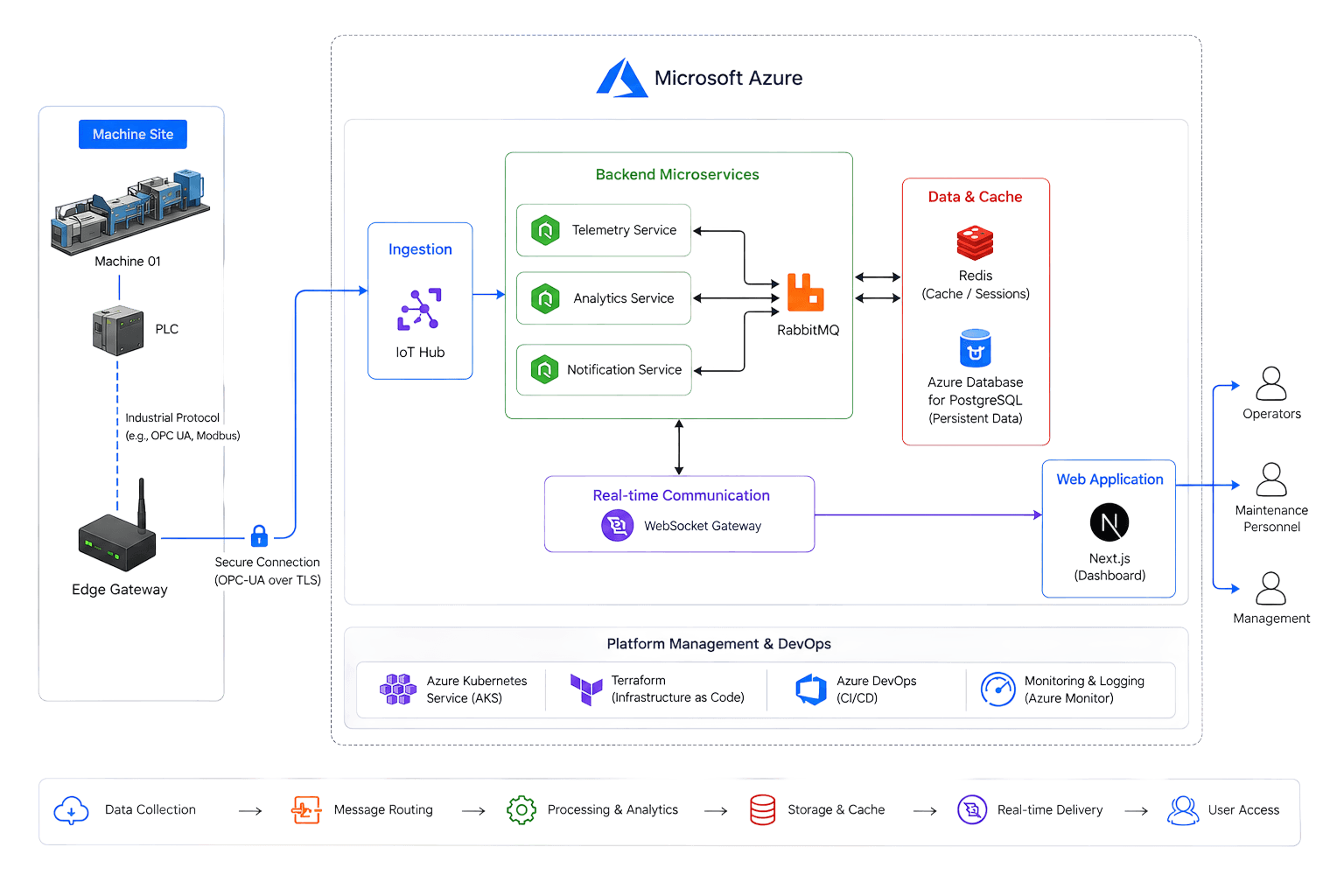
Mindtech Apps is developing a comprehensive Industry 4.0 software platform for a manufacturer and operator of industrial surface treatment machinery, transforming traditionally isolated industrial equipment into cloud-connected, data-driven systems. The project focuses on creating a centralized industrial IoT ecosystem that connects PLC-controlled machinery deployed across multiple customer sites with a secure, scalable cloud platform. Through PLC-to-cloud integration, real-time telemetry processing, machine monitoring, and advanced operational analytics, the solution enables manufacturers and equipment operators to gain greater visibility into machine performance, operational efficiency, and maintenance requirements.
Our engineering team is responsible for developing the end-to-end software architecture, including industrial connectivity, cloud-native backend microservices, a real-time web management platform, and shop-floor operator terminals. Built using NestJS, Next.js, TypeScript, Microsoft Azure, Kubernetes, OPC UA, Modbus TCP, RabbitMQ, and Redis, the solution is designed to support both cloud-hosted and standalone on-premises deployments, providing the flexibility required in modern industrial environments.
The project demonstrates how industrial machinery manufacturers can extend their existing equipment with connected software capabilities, transforming traditional machines into intelligent, remotely monitored assets and establishing a foundation for new digital services.
The Challenge: Connecting Industrial Equipment Across Distributed Customer Sites
Industrial machinery manufacturers face increasing pressure to deliver more than reliable hardware. Customers now expect connected equipment, real-time operational insights, remote monitoring capabilities, and tools that help minimize downtime and improve production efficiency.
However, industrial machines are often deployed across geographically distributed customer facilities, operating within separate local networks and relying on PLC-based control systems that were not originally designed for centralized cloud connectivity.
Our client needed a modern software platform capable of connecting these industrial assets while preserving reliable local operations and accommodating different deployment environments.
The solution had to address several important engineering challenges:
- PLC-to-cloud connectivity: Establishing reliable and secure communication between industrial control systems and cloud-based applications.
- Real-time machine monitoring: Collecting operational status, production metrics, diagnostic information, and equipment events.
- Distributed industrial infrastructure: Managing machinery operating across multiple customer sites through a centralized platform.
- Industrial protocol integration: Supporting OPC UA communication with PLCs and Modbus TCP connectivity for energy monitoring devices.
- Cloud and on-premises deployment: Providing flexibility for customers with different IT policies, connectivity requirements, and infrastructure constraints.
- Scalable data processing: Handling continuous telemetry streams and asynchronous events from multiple connected machines.
- Shop-floor visibility: Giving operators direct access to machine information, workflows, and production instructions.
Mindtech was tasked with designing a flexible industrial software architecture that addresses these requirements while providing a scalable foundation for future Industry 4.0 capabilities.
PLC-to-Cloud Integration and Industrial IoT Connectivity
One of the central components of the project is the development of a robust PLC-to-cloud integration architecture, connecting industrial machines with the centralized software ecosystem. Our solution integrates directly with PLC-controlled equipment using OPC UA (Open Platform Communications Unified Architecture), an industry-standard communication protocol widely used in industrial automation.
Through this integration, the platform collects machine telemetry, operating states, production information, alarms, and diagnostic events, making relevant data available to cloud-based applications. We also implemented Modbus TCP integration for industrial energy meters, enabling the platform to capture electricity consumption data alongside operational machine metrics. By consolidating machine performance and energy information, the system establishes a foundation for analyzing resource utilization, operational efficiency, and equipment consumption patterns.
The industrial connectivity layer bridges the gap between operational technology (OT) and information technology (IT), enabling machine-generated data to be processed by modern cloud services without replacing existing PLC-based control systems.
This approach is particularly valuable for industrial machinery manufacturers and OEMs looking to cloud-enable their existing equipment, introduce connected services, or modernize their installed machine fleets. Rather than requiring a complete hardware redesign, the platform extends the capabilities of existing industrial infrastructure through software integration.
Cloud-Native Industrial IoT Platform with NestJS Microservices
To support reliable data processing and long-term scalability, we are developing the backend platform using a microservices architecture built with NestJS and TypeScript. The architecture separates core system responsibilities into independently maintainable services, creating a flexible foundation for industrial data ingestion, equipment management, operational workflows, and real-time information delivery.
This modular approach allows individual components to evolve as new machines, data sources, and business requirements are introduced.
For asynchronous communication between services, we use RabbitMQ, enabling reliable message exchange across the backend platform.
Message-driven communication is particularly important in industrial IoT environments, where data originates from multiple machines and must be processed by different services without creating unnecessary dependencies between system components.
We also use Redis for high-performance caching, session management, and low-latency access to frequently requested data, helping maintain responsive application performance. Together, NestJS, RabbitMQ, and Redis provide a modern backend foundation for managing industrial telemetry, operational events, and distributed equipment data. The architecture is designed to support increasing numbers of connected assets and evolving analytical requirements while maintaining clear separation between system components.
Real-Time Industrial Equipment Monitoring with WebSockets
For industrial operators and maintenance teams, access to current machine information is essential.
We are implementing WebSocket-based real-time communication to deliver live machine updates directly to the management platform and shop-floor interfaces. Instead of relying on periodic manual refreshes, users can monitor changes in machine status as updated information becomes available. The system provides visibility into operational parameters such as equipment health, machine utilization, production efficiency, active alarms, and operational anomalies.
Through centralized dashboards, users can observe the condition of connected machinery and identify situations requiring attention.
Real-time monitoring also supports more efficient communication between production operators, maintenance personnel, and management teams by making relevant operational information available within a shared digital environment. For industrial equipment manufacturers, these capabilities create opportunities to deliver remote machine monitoring services and strengthen long-term customer relationships through connected software products.
Smart Factory Dashboards and Industrial Web Application Development
We are developing the user-facing platform using Next.js and TypeScript, creating a modern industrial web application for monitoring, analyzing, and managing connected equipment. The application brings information from distributed industrial assets into a centralized interface, making operational data accessible to authorized users.
Core functionality includes real-time machine dashboards, equipment status monitoring, alarm and notification management, historical analytics, maintenance planning, and operational reporting. The interface is designed to serve different operational roles, from shop-floor personnel who need immediate machine status information to management teams seeking broader performance insights. By combining live telemetry with historical operational data, the platform supports more informed decisions about machine utilization, maintenance priorities, and production performance.
The result is a unified digital environment that transforms machine-generated data into accessible operational information.
Shop-Floor Terminals and Connected Production Workflows
In addition to the centralized management platform, the project includes dedicated shop-floor terminals deployed within the production environment.
These terminals extend the industrial IoT ecosystem directly to the point of operation, allowing production personnel to interact with relevant machine information without leaving the shop floor. Through the terminal interfaces, operators can access real-time machine status, production workflows, operational instructions, and key performance indicators. This creates a direct connection between machine-generated data and the employees responsible for day-to-day equipment operation.
By integrating shop-floor terminals with the same backend platform used for centralized monitoring, the solution helps maintain consistent operational information across different interfaces. The approach supports more efficient production supervision, better access to instructions, and greater visibility into manufacturing workflows. It also demonstrates how industrial application development and connected operator interfaces can complement PLC-controlled machinery and traditional industrial automation systems.
Microsoft Azure Cloud Infrastructure and Kubernetes Deployment
The platform is being developed for deployment on Microsoft Azure, using cloud-native technologies to support scalability, availability, and operational resilience. We use Kubernetes for container orchestration, enabling the backend microservices to be deployed, managed, and scaled within a structured infrastructure environment. Containerization provides consistency across application environments and simplifies the management of services as the platform grows. A key architectural requirement is the ability to support both cloud-hosted and standalone on-premises deployment.
This flexibility is particularly important for industrial organizations, where some production facilities operate under strict network restrictions or require local infrastructure for operational, security, or business reasons. By supporting different deployment models, the solution can accommodate a wider range of industrial customer environments while maintaining a consistent software architecture. This approach enables machinery manufacturers to introduce cloud-connected services without excluding customers who require on-premises operation.
Infrastructure as Code, Azure DevOps, and Automated CI/CD
Reliable software delivery is essential for complex industrial platforms that combine machine connectivity, distributed backend services, and multiple user-facing applications. We manage infrastructure provisioning and environment configuration using Terraform, applying Infrastructure as Code principles to create consistent and reproducible deployment environments.
Development workflows, project governance, release management, and continuous integration are managed through Azure DevOps.
Our CI/CD pipelines support automated software delivery processes across development, testing, and production environments.
Combined with Kubernetes-based deployment, these practices help reduce manual infrastructure management and support more predictable releases.
The result is an engineering environment designed for maintainability, continuous improvement, and enterprise-grade software delivery.
Agile and AI-Driven Industrial Software Development Throughout the project, we combine agile development practices with AI-assisted software engineering methodologies, supporting efficient implementation and continuous iteration. Our engineering team works closely with project stakeholders to align software architecture, industrial integration requirements, and user-facing functionality with the manufacturer's business objectives. AI-assisted development workflows support repetitive engineering tasks, implementation, and code refinement, while experienced engineers remain responsible for architecture, integration reliability, code review, and critical technical decisions.
This human-led approach is particularly important in industrial software development, where communication with physical equipment and the reliability of operational information require careful engineering oversight. By combining modern development practices, cloud-native technologies, and close collaboration, we are building a platform designed to evolve alongside the manufacturer's connected equipment strategy.
Industry 4.0: Turning Traditional Machinery into Cloud-Connected Products
The project represents an important step toward transforming conventional industrial machinery into connected, software-enabled products.
By integrating existing PLC-controlled equipment with modern cloud infrastructure, the manufacturer can introduce capabilities that extend beyond the machine's original control system. Instead of relying exclusively on local machine interfaces and manual diagnostics, operational data can become accessible through centralized monitoring and analytics tools.
This creates opportunities for remote service capabilities, improved maintenance planning, equipment performance analysis, and new digital products built around the manufacturer's installed machinery. The platform also establishes a technical foundation for future enhancements, including predictive maintenance models, advanced energy analytics, automated service notifications, and broader smart factory integrations.
For industrial OEMs, this transformation can support the evolution from traditional equipment manufacturing toward connected machinery, digital services, and data-driven customer support models.
Project Outcomes and Business Value
The ongoing development project is establishing a scalable software foundation for managing and monitoring industrial surface treatment equipment across distributed customer sites.
By connecting PLC-controlled machinery to cloud-native software services, Mindtech is helping the manufacturer introduce greater operational visibility and build the infrastructure required for future connected equipment offerings.
Key capabilities being delivered include:
- PLC-to-cloud integration using OPC UA to connect industrial machinery with centralized software services.
- Industrial energy monitoring through Modbus TCP integration with energy metering devices.
- Real-time equipment monitoring using WebSockets for live machine status, telemetry, and alarm updates.
- Cloud-native microservices built with NestJS, RabbitMQ, and Redis for scalable industrial data processing.
- Industrial management dashboards developed with Next.js and TypeScript.
- Connected shop-floor terminals providing operators with machine information and production workflows.
- Microsoft Azure and Kubernetes infrastructure supporting scalable cloud deployment.
- Standalone on-premises deployment capability for industrial customers with specific infrastructure requirements.
- Terraform and Azure DevOps automation supporting reproducible infrastructure and structured CI/CD processes.
The platform is designed to enable better equipment visibility, more informed maintenance decisions, and improved operational transparency as development and deployment progress.
Beyond the immediate functionality, the solution provides a foundation for predictive maintenance, remote equipment services, and future industrial digitalization initiatives.
Your Partner for PLC-to-Cloud Integration and Industrial IoT Development
Industrial machinery manufacturers increasingly need software solutions that connect existing equipment to modern cloud infrastructure.
At Mindtech Apps, we help industrial companies and equipment manufacturers design, develop, and scale cloud-connected machinery platforms, industrial IoT systems, and Industry 4.0 software solutions. Our expertise spans PLC integration, OPC UA, Modbus TCP, industrial data processing, cloud-native microservices, Azure infrastructure, real-time monitoring dashboards, and custom industrial applications.
Whether you're looking to connect an existing fleet of PLC-controlled machines to the cloud, develop a remote equipment monitoring platform, or build new digital services around your industrial products, our engineering team can help create a solution that fits your technical and business requirements.
We combine industrial integration expertise with modern software engineering, AI-assisted development, agile collaboration, and automated DevOps practices to deliver maintainable systems designed for long-term growth.
Let's connect your industrial machinery to the cloud.
Technologies: OPC UA, Modbus TCP, NestJS, Next.js, TypeScript, Microsoft Azure, Kubernetes, Terraform, Azure DevOps, RabbitMQ, Redis, WebSockets, PLC Integration, Microservices
Services: Industry 4.0 Software Development, Industrial IoT Development, PLC-to-Cloud Integration, Cloud-Native Application Development, Industrial Web Application Development, Industrial Data Integration, DevOps, Infrastructure as Code, AI-Assisted Software Development
Industries: Industrial Machinery Manufacturing, Surface Treatment Equipment, Industrial Automation, Smart Manufacturing, Industrial IoT